One year on: teams remain at the forefront of tackling deconditioning
One year into a workstream to prevent hospital-acquired deconditioning, teams across NHS Wales remain at the forefront of efforts to improve outcomes and reduce harm for patients across Wales.
Supported by NHS Wales Performance and Improvement, teams in the Safe Care Partnership’s Preventing Deconditioning workstream are continuing to progress projects to deliver safer, more person-centred care, alongside participating in an exciting new phase of ‘world-leading’ work.
Deconditioning: A quality and safety improvement priority
Deconditioning is a complex process used to describe the loss of a person’s fitness and functional ability following a period of inactivity, bedrest or due to a sedentary lifestyle. Typically, it can affect a person’s cognitive function, continence, muscle strength and ability to undertake simple, daily tasks.
Deconditioning can start within a matter of hours when a person is first admitted to hospital and can have long-term devastating effects. It is recognised as a key quality and safety priority for Welsh Government, NHS Wales Performance and Improvement as well as health boards and trusts across Wales.
Work began on the Preventing Deconditioning workstream in October 2024 with a major co-design event bringing together partners, public and patient contributors, and health boards and trusts across Wales. In response to the event feedback, it was decided that the workstream would follow a learning collaborative model loosely based on the Institute for Healthcare Improvement (IHI)’s Breakthrough Series Collaborative model.
“By using the IHI collaborative model as a basis, we could work within a defined structure that was familiar to some colleagues and partners who worked with us in the first phase of the Safe Care Partnership.
“Having set dates for learning sessions and coaching calls, as well as dedicated time in between to implement learning, allowed teams to autonomously progress their projects at a pace that was manageable for them”, said Dom Bird, Acting National Director for Quality Safety and Improvement, NHS Wales Performance and Improvement.
Earlier this year, NHS Wales Performance and Improvement invited staff who worked, and have an interest, in deconditioning to a webinar explaining how the workstream would work, how long it would run for and how people could apply.
Working across borders
Just under 30 teams from health boards and trusts were selected to join the workstream with projects that focused on one of the four themes of deconditioning; prevent and identify deconditioning, promote functional activity, continence management and cognitive function. Teams from Bristol and Northern Ireland trusts also joined, wanting to learn from examples adopted in Wales which could be shared across borders.
Continuing the focus on co-design, the workstream ensured that project teams and patient and public representatives helped shape the running of the programme throughout and learning was captured and shared among the whole group.
Reflecting on the group’s collective efforts, Adam Didcott, Improvement Lead, NHS Wales Performance and Improvement, said: “We’ve seen incredible commitment from teams across Wales and beyond to help prevent deconditioning and support safer, more independent recovery for patients. Teams have been extremely open in the progress they’ve made and willing to share ideas that could be replicated across other areas in our NHS system.”
Teams celebrated at national event
The workstream was celebrated at the National Preventing Deconditioning Summit in November, which brought together health professionals, stakeholders and partners in the preventing deconditioning space.
The Summit featured keynote speakers including Jeremy Miles MS, Cabinet Secretary for Health and Social Care, renowned Professors Brian Dolan and Sally Lewis and new Chief Executive of NHS Wales and Director General for Health, Social Care and Early Years, Jacqueline Totterdell, who acknowledged how “Wales is leading the charge” in this important field.
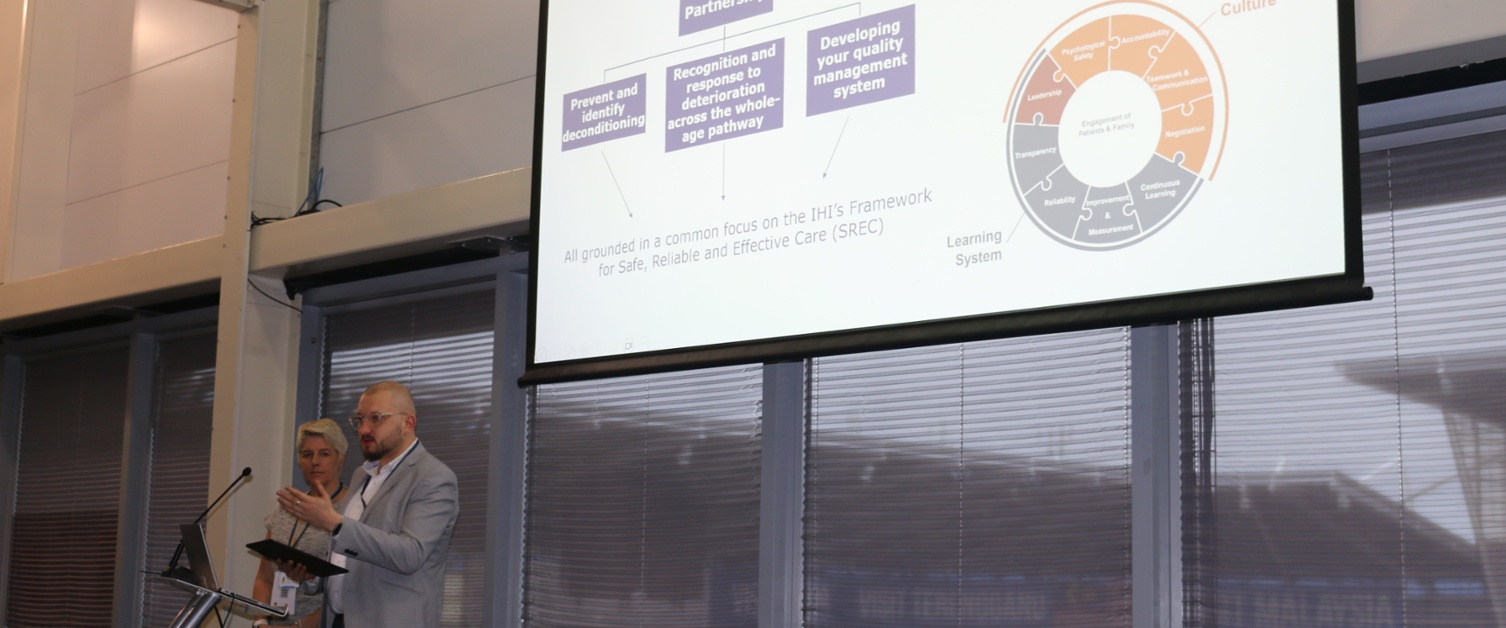
Project teams’ posters summarising their progress were displayed at the event and formed part of a competition. Patient and public contributors, as well as representatives from project teams, were also in attendance at the Summit, with some teams presenting their work on stage.
“It was great to have teams from Betsi Cadwaladr University Health Board and Cardiff and Vale University Health Board present their work centre stage at the Summit and mark the progress that’s been made as part of this learning collaborative. This work has shown what’s possible when we collaborate with shared purpose and ambition”, commented Adam.
Workstream next steps
Also unveiled at the Summit was the Deconditioning Early Warning Indicator (DEWI), a new first-of-its-kind tool that supports staff to spot the early signs of hospital-acquired deconditioning and intervene to aid its prevention.
“We’re thrilled to continue working with the Six Goals for Urgent and Emergency Care National Programme team who are supporting teams from the workstream to consider trialling the DEWI tool as part of their established projects. As an organisation, we’ll also be working with other teams across Wales interested in piloting the tool so we can continue to build momentum and gather as many insights as possible”, Adam concluded.
You can find out more information about our work on preventing deconditioning and the new DEWI tool on our website.