Quality Management Systems - Our journey towards supporting national implementation
18 March 2026
Ahead of joining Professor Amar Shah, National Clinical Director for Improvement for an NHS IMPACT Masterclass about Quality Management Systems (QMS), Dom Bird, Acting National Director for Quality, Safety and Improvement has blogged reflecting on the organisation’s ongoing journey to understand QMS, and support for organisations across NHS Wales to establish their own QMS to achieve high quality care.
---
 A QMS helps a healthcare organisation to plan, monitor, improve and assure the quality of care it provides.
In NHS Wales, we define it as an operating framework that enables healthcare organisations to continuously, reliably and sustainably meet the needs of the population it serves.
While those sentences describe what is expected of an effective QMS in quite simple terms, achieving it in the context of our complex healthcare systems poses a real challenge - one that we are required to meet by the Duty of Quality within the Health and Social Care (Quality and Engagement) (Wales) Act 2020.
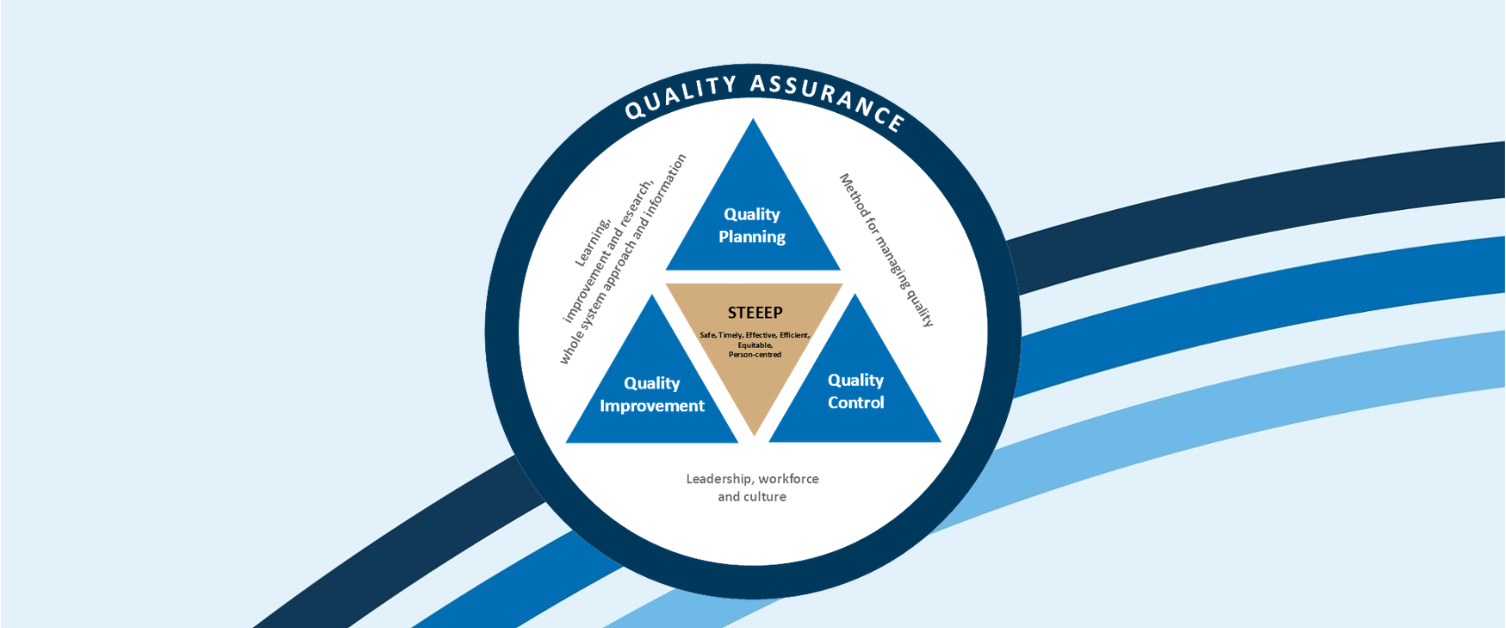
A QMS is how we operate, not within a single project or team but through a whole-system approach, to manage quality across all levels. It’s how we arrange ourselves to understand why we are here, assess how we’re doing in working to fulfil that purpose, identify where we need to improve, and go on to achieve that improvement to provide the best possible quality care.
But how do we get there?
Our own QMS journey
When we first established our QMS as Improvement Cymru, we started with quality planning. We were redefining ourselves as we came back together following the COVID-19 pandemic response.
We needed to bring in intelligence from different sources, ranging from partners we worked with day-to-day to the international improvement community, to understand what we needed to focus on and most importantly, how we needed to deliver that work to meet the needs of our key service users.
We asked them what was most important in the way we operated and heard that they collectively valued the personal interface, reliability, flexibility and performance of our team. They also helped us define what they needed from us.
We developed our purpose statement in response to that need, which was integrated into meeting agendas and performance appraisal cycles, and used to test the value of new requests for work. We began supporting our teams to develop their own purpose statements so that they could see the connection of their own work to the overarching purpose and gain a sense of identity as we rebuilt following the pandemic.
We next set about identifying the products and services that would help achieve our purpose. We categorised them into expertise, networking, support, and horizon scanning and thought leadership. In doing this we were able to identify work that needed to continue as it had always been delivered but also where delivery needed to change. We also began work on standardising our products and services to ensure our service users experienced the same quality from us, regardless of who they were interfacing with, or where.
One of the most meaningful things we did was to map our internal system - the processes that came together to create the products and services we delivered to health boards, trusts and Welsh Government. This was key to the quality control part of our QMS. We needed to understand how our collective efforts came together and where there were deficiencies in our processes that we could target for improvement. By standardising processes, we could improve the quality of delivery across our programmes. These became our improvement projects – connecting quality improvement with quality control.
The final piece of our QMS was quality assurance. We established our vector of measures - a small set of measures that would tell us how well we were working. We tried several different options to develop these but finally reached a balanced scorecard approach. The measures weren’t about what we delivered, they were about how we delivered our work, how it was received and how our staff we were doing in delivering the work. The measures all use time series data, and the ambition is for the data to be reviewed at all leadership team meetings.
More recently, within NHS Wales Performance and Improvement’s Quality, Safety and Improvement directorate, we have continued to use and iterate our purpose, system map and vector of measures and this has led to new improvement projects for 2026, such as designing our engagement and feedback processes and redesigning our quality planning process and vector of measures.
We have learnt along the way that to achieve our QMS, our leadership team needed to draw in a layer of our broader team to support and deliver on the approach. As a result, we have a much clearer understanding of how our work gets done and what needs to be improved – and most importantly, what matters our service users and our role in supporting them to achieve it.
Supporting QMS across NHS Wales
In February 2025, we published our QMS Framework and methodology in the paper Developing a Quality Management System, which you can read here. The framework was developed from extensive research, interviews with high performing healthcare organisations and our own experience, dating back to when we were Improvement Cymru.
The framework and methodology provide an evidence-based approach that organisations across NHS Wales can adopt to establish an effective QMS, placing focus on the alignment of quality control, quality planning, quality improvement and quality assurance.
Recognising the challenge of translating the framework into a working QMS in the real world, particularly in the context of our complex healthcare systems, we’re working with partners to provide a programme of support to colleagues throughout NHS Wales who are working to build their organisation’s QMS.
The offer includes facilitating a learning and delivery network, providing Board development sessions, supporting two health board directorates to prototype QMS and share their learning, and developing our growing QMS Hub of resources, which you can visit here.
There’s a long way to go, and organisations throughout NHS Wales certainly face a challenge to establish their QMS. We’re looking forward to supporting them to achieve that, towards the highest quality possible care being provided to people across Wales.
Find out more
If you’re interested in learning more about QMS in the context of healthcare, sign up to attend the NHS IMPACT Masterclass on Quality Management Systems, 12.30pm – 1.50pm on Monday 23 March.