Cellular Pathology teams drive continuous improvement for cancer patients in Wales
Health boards across Wales are using cross-team working and open collaboration to help drive more efficient cancer diagnosis for people in Wales, with the support of the All-Wales Cancer Cellular Pathology Collaborative.
The Collaborative, hosted by NHS Wales Performance and Improvement (NHSP&I), is designed to support health boards across Wales achieve the Single Cancer Pathway (SCP); a Welsh Government target for diagnosing cancer and starting treatment more quickly. The SCP, which was implemented in 2019, requires every Welsh health board to ensure patients start treatment within 62 days from the first point where cancer might be suspected.
Diagnostics in the driving seat
To help identify barriers and delays to achieving the SCP, NHSP&I and health boards across Wales have been working with vehicle manufacturer Toyota since 2022 to help streamline the cancer pathway through lean methodology. When reviewing the pathway through this work, which was initially commissioned by the Wales Cancer Network, they identified a bottleneck in the diagnostics stage.
Diagnostics is used to describe the process of running medical tests and procedures to determine if cancer is present and if so, identifying its type and stage. Departments based in diagnostics include endoscopy, medical imaging or radiology, and cellular pathology.
“We decided to focus our work on cellular pathology as this department is process-driven which lends itself to the lean approach. We found that the main bottleneck in diagnostics was getting the biopsy results to the multi-disciplinary team (MDT) in a timely manner, so an agreed course of treatment can efficiently be communicated back to the patient.
“As we had an engaged audience and a defined timeline to work within, we decided to adopt a collaborative model to fast track this work, which has proven methods to spread outstanding improvements across the system”, said Rosalyn Davies, Improvement Lead, NHS Wales Performance and Improvement.
Collaboration at its core
A collaborative is based on the Institute for Healthcare Improvement (IHI)’s Breakthrough Series (BTS) Collaborative model, which consists of a series of in-person and virtual learning sessions with action periods in between, where typically teams look to trial improvements and report back if they’ve been successful.
It’s been more than nine months since the Collaborative first started with membership comprising biomedical scientists, senior managers, consultant pathologists and other staff from cellular pathology laboratories across six health boards. There’s also a faculty consisting of consultants, clinical leads and directors who bring experience and expertise from their respective fields.
Jonathan Clarke, Clinical Lead, NHS Wales Performance and Improvement, added, “We are continually co-designing how the Collaborative should be run with teams, as this is a learning process that needs to work for members. The intended culture of collaboratives allows teams to openly share and learn from each other; we’ve put a lot of effort into ensuring that members feel psychologically safe when sharing their progress.”
Building a culture of safety
Psychological safety can be described as feeing safe within a workplace to openly express ideas, admit mistakes and to respectfully question or challenge colleagues, without fear of any retaliation or detrimental effects. Operating a psychologically safe culture is a crucial part of providing safe patient care, as modelled in the Framework for Safe, Reliable and Effective Care (SREC).
“Building a psychologically safe culture takes time, especially as we continue to operate in an ever-growing virtual world. As the Collaborative is made up of staff based across Wales, the most practical and cost-efficient method of keeping in touch is through online meetings.
“To help bring staff together in this setting we ask each health board to chair a monthly coaching call session, so the responsibility is shared equally among members. We always ask for members’ input into how sessions should be run and the topics that they want covered, so this gives them a sense of ownership over the Collaborative. By seeing their colleagues in other health boards be so open in the calls allows for all members to be candid with any barriers they’ve faced and how they’ve overcome these, as well as share improvements they’ve observed using data collection with others, encouraging learning.
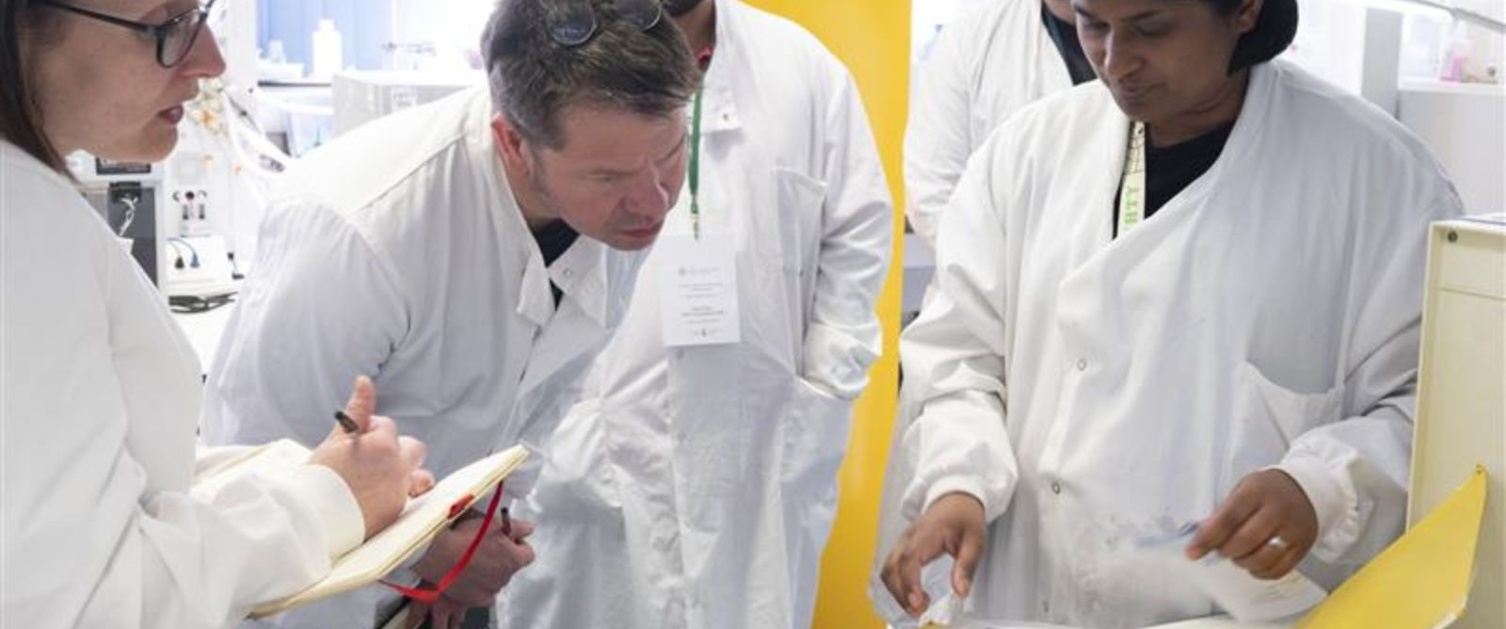
“However, that’s not to say that in-person time isn’t valued by our members. During each of the in-person learning sessions, we facilitate teams to visit each other’s laboratories which is where teams have really reaped the rewards of knowledge sharing in laboratory processes and flow”, added Jonathan.
Sharing across health boards
One example of collaborative learning came from when the team from Aneurin Bevan University Health Board (ABUHB) visited the lab at Cardiff and Vale University Health Board (CAVUHB) as part of an organised in-person learning session. The team at CAVUHB presented their ‘float role’ change idea. This refers to a person solely responsible for picking up ad-hoc and administrative tasks that were taking clinical teams away from dissecting samples and ultimately, reducing backlogs in labs. With the help of lean training, CAVUHB could demonstrate the time saved by having this role in place and the number of patients who received their results more quickly. ABUHB, experiencing the same concerns as CAVUHB, took this learning and data back to their health board.
Similarly, at the most recent learning session in October, the team at Hywel Dda University Health Board (HDUHB) hosted members at their laboratory and presented the improvements they’ve made to date through lean methodology, with minimal financial investment. However, the biggest takeaway for the team so far is the ‘mindset’ allowing the team to ‘experiment without fear of failure’ when looking to make changes to processes.
“It is proven that the more time spent as a group, and the more that psychological safety is established, teams are willing to adopt similar change ideas from others where relevant, rather than reinventing the wheel.
“Teams continue to say that they feel more bonded, enthusiastic to make improvements and appreciate the dedicated time to come together thanks to the format of the Collaborative.
“Although we’re halfway through, teams have made so much progress already and the results are starting to show. I’m excited to see what lies ahead within the next few months”, concluded Ros.
Further updates on the Collaborative will be published on the NHSP&I website.