New research explores barriers and opportunities for improving integrated care services for children and young people with a learning disability in Wales
12 January 2026
The delivery of effective and integrated care for children and young people with a learning disability in Wales is inconsistent with gaps in integration, according to new research to explore the experiences of professionals working in health, social care, and education.
The research looks in detail at how professionals who work across Wales experience and make sense of the services they provide, highlighting some positive examples of multi-agency working but also frustrations of fragmented collaboration between sectors.
NHS Wales Performance and Improvement’s Learning Disability Programme commissioned Dr Dawn Jones, Senior Lecturer at Wrexham University, to conduct the research that has shed light on the experiences of professionals, highlighting both challenges and opportunities for improving integrated care.
The research project follows an earlier literature review and evaluation of national care models and frameworks for providing care for children and young people with a learning disability in Wales. The latest publication is the third and final instalment of the research series, adding to a growing body of evidence to support the need for patient-centred care.
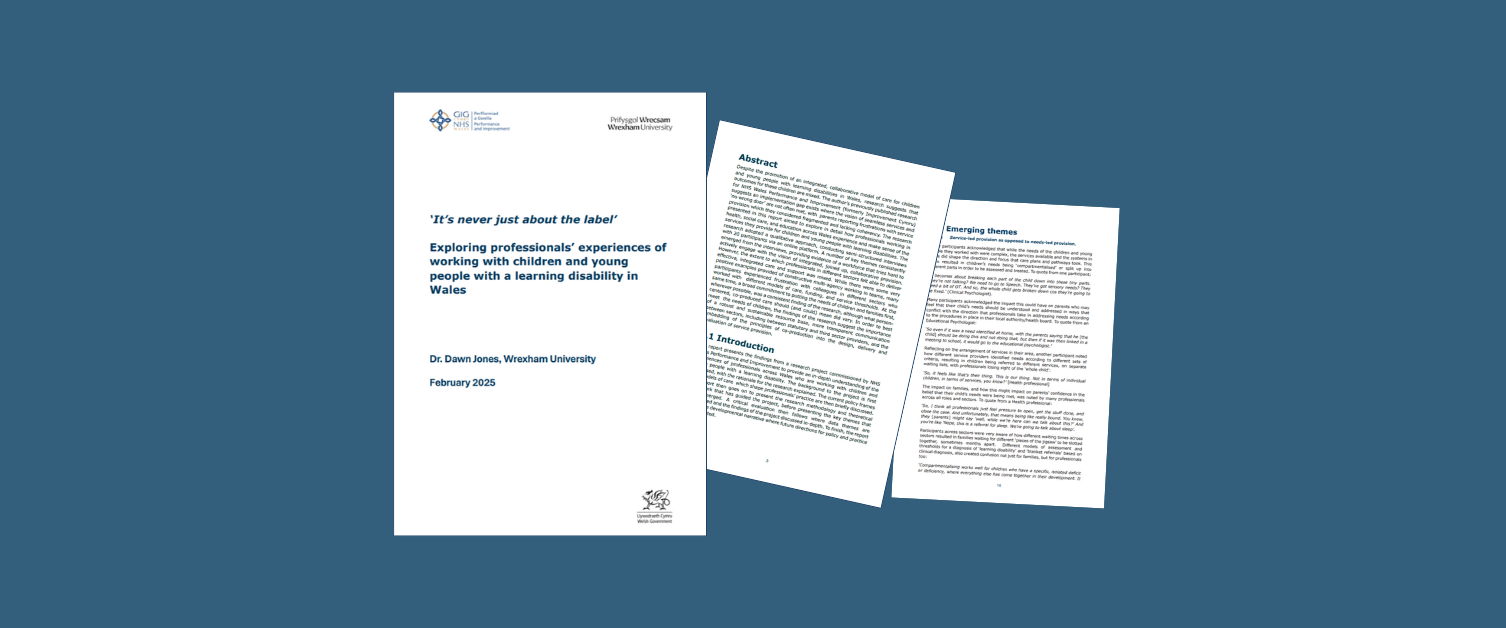
- Exploring professionals’ experiences of working with children and young people with a learning disability in Wales
- Exploring parents' and carers' experiences of accessing care and support services for their child with a learning disability
-
Evaluation of the Children with Additional Needs (CAN) Pathway
Key findings
The findings will be shared with Regional Partnership Boards across Wales, and other multi-disciplinary forums and communities of practice.
Some of the key findings include:
-
A committed workforce: The reality of integrated services may fall short due to structural and systemic challenges, but professionals working in the system are deeply committed to supporting children and young people with a learning disability in Wales. Many respondents shared examples of constructive multi-agency collaboration and emphasised the importance of child-centred, needs-led care.
-
Fragmented care: Professionals reported that service pathways can be rigid, requiring children to fit into predefined models rather than services adapting to individual needs. This ‘compartmentalisation’ of care - where children are assessed separately for speech therapy, occupational therapy, or education support - can lead to delays, duplication, and frustration for both families and professionals.
-
Inconsistent collaboration: While some professionals work closely with colleagues across health, social care, and education, others reported barriers caused by differing models of care, funding mechanisms, and assessment criteria. As a result, families often feel they must navigate a complex system on their own.
-
The role of co-production: The importance of co-production, when professionals work alongside service users and their families to design and deliver services, was highlighted in the research. The extent that co-production is embedded in services varies significantly, with some professionals expressing concerns that resource constraints limit meaningful engagement with families.
-
A call for sustainable change: A key recommendation is for more consistent multi-agency working practices to ensure services work together and provide holistic support. The research outlines the need for transparent communication between sectors, with the embedding of co-production principles into service design and delivery.
About the authors
NHS Wales Performance and Improvement’s Learning Disability Programme works to create a safer and fairer Wales for people living with a learning disability. The programme works with people throughout Wales to deliver projects that improve the health and wellbeing of people with a learning disability because everyone in the community deserves effective and efficient care that meets their individual needs.
Dr Dawn Jones has been a member of the Social Sciences team at Wrexham University since 2007 and teaches on both the Sociology and Social Work programmes. She is now joint Programme Leader for the BA (Hons) Sociology degree.
An active sociology researcher, Dr Jones has published across the field of sociological theory, social policy, and the sociology of risk. She is also a research adviser to the Welsh Assembly Local Government Data Unit, where she advises on matters of research and policy.